
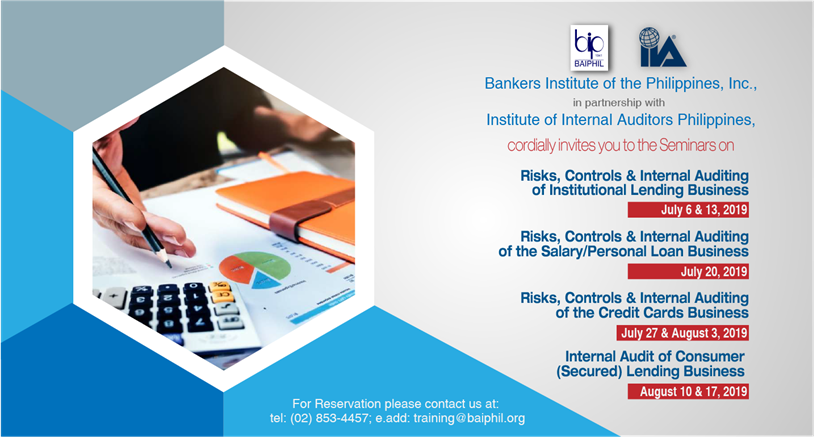
Description
Course Description:
New technologies, product innovation, volume and speed of transactions have transformed the banking landscape, particularly in the consumer lending business. The dynamic and complex business and regulatory environment makes it very challenging for banks to continuously maintain and implement sound and effective Consumer (Business) Lending Control, Risk Management and Governance Framework.
The value that an Internal Audit Activity brings to the organization largely resides on the objective and independent assessment of the control, risk management and governance processes, as related to the business objectives set. Compliance with governing laws, rules and regulations and policies of the organization is likewise evaluated, considering the impact to the business of the deviations. And, in the process, globally applied auditing standards and control and risk management assessment frameworks are observed in the conduct of the audits. This Training Program will provide bank auditors, risk practitioners and operational management person with comprehensive knowledge and guidance to be able to carry out adequate and meaningful audits, risk management reviews and risk and control self-assessment reviews, respectively. This program will also provide a venue for workshop and group discussions in order to facilitate the learning effectiveness for the participants.
Course Outline:
I. Understanding the Consumer (Secured Lending Business, Products, Business Objectives and Core Processes
a. Strategic Thrust for Consumer (Secured) Lending Business
b. Product Definition and Features
c. Key Business Objectives and Top Risks
d. Core Processes
II. Governance Framework
a. Board of Directors
b. Senior Management
c. Operational Management
III. Three Lines of Defense
IV. The Key Risks and Controls Identification, Assessment, and Monitoring and Examples of Audit Issues
a. Indicators under the different elements of the Assessment Frameworks
b. Corresponding Audit Issues Commonly Noted
V. Preliminary Assessment and Audit Strategy Formulation
VI. The Audit Program Guides Development
VII. Audit Results
a. Evaluation of the Controls, Residual Risks, and Audit Issues
b. Analysis of Opportunities for Improvement
c. Assessment of Management’s Response/Action
VIII. Reporting of Audit Results to the Audit Committee and Discussion with Senior Management
a. Advanced Reporting of High Risk Issues
b. Contents of the Executive Summary
IX. Audit Issues Follow-through/Monitoring
X. Overall Audit Assessment and Rating
Schedule/s and Venue:
August 10 & 17, 2019; 8:30 A.M. to 5:00 P.M.
Dusit Thani Manila, Ayala Center, Makati City